




Automated Battery Pack Line – Still “Stacking People” Instead of Building Efficiency?
Have you ever run the numbers?
A 10 ppm PACK line—if you are still relying on manual handling, manual welding, and manual inspection—how much extra labor cost are you burning through each year? And that is before factoring in night-shift efficiency drops, turnover, and training overhead.
Problem #1: Low Automation = High Labor Costs
This is not just about “labor shortage.”
The deeper issue is structural: many lines were originally designed with “human flexibility” as a contingency plan—and that contingency quietly became the core operating model.
Manual cell loading. Manual barcode scanning. Manual welding positioning. Manual data entry.
Each step looks flexible—until you realize each step is burning margin.
Worse still, the more human touchpoints, the harder it is to guarantee cycle time.
A 10 ppm design often stalls at 5–6 ppm on manual lines. You are paying for two lines and getting the output of one.
The fix is not bolting on a few standalone machines.
It is a holistic redesign across three dimensions:
-
Whole-line material flow logic
-
Cycle-time synchronization
-
Closed-loop data infrastructure
Roller conveyors with automatic return, independent empty-tray recirculation, and MES-driven real-time data capture are not optional extras—they are baseline requirements for sustainable headcount reduction.
Problem #2: Poor PACK Consistency = Yield Loss
Battery modules are not “assembled and done.”
A skewed busbar weld, insufficient pole cleaning, or stacking deviation can scrap an entire pack.
Consistency is difficult because there are too many process control points—and too little feedback.
Welding power, cleaning effectiveness, press force, CCD inspection criteria—when each station operates as an island, defects are discovered only after they have already cost you yield.
The shift must move from post-process inspection to real-time control:
-
CCD inspection at every critical station
-
Vision-guided alignment
-
Real-time welding parameter monitoring
-
Automatic rejection of defective cells
Not for show. But to push yield from ~95% toward 99.8%.
Who Can Deliver All of This in One Integrated Line?
PENGDAO has already proven it.
-
Square-cell module PACK line – 15 ppm single-line capacity
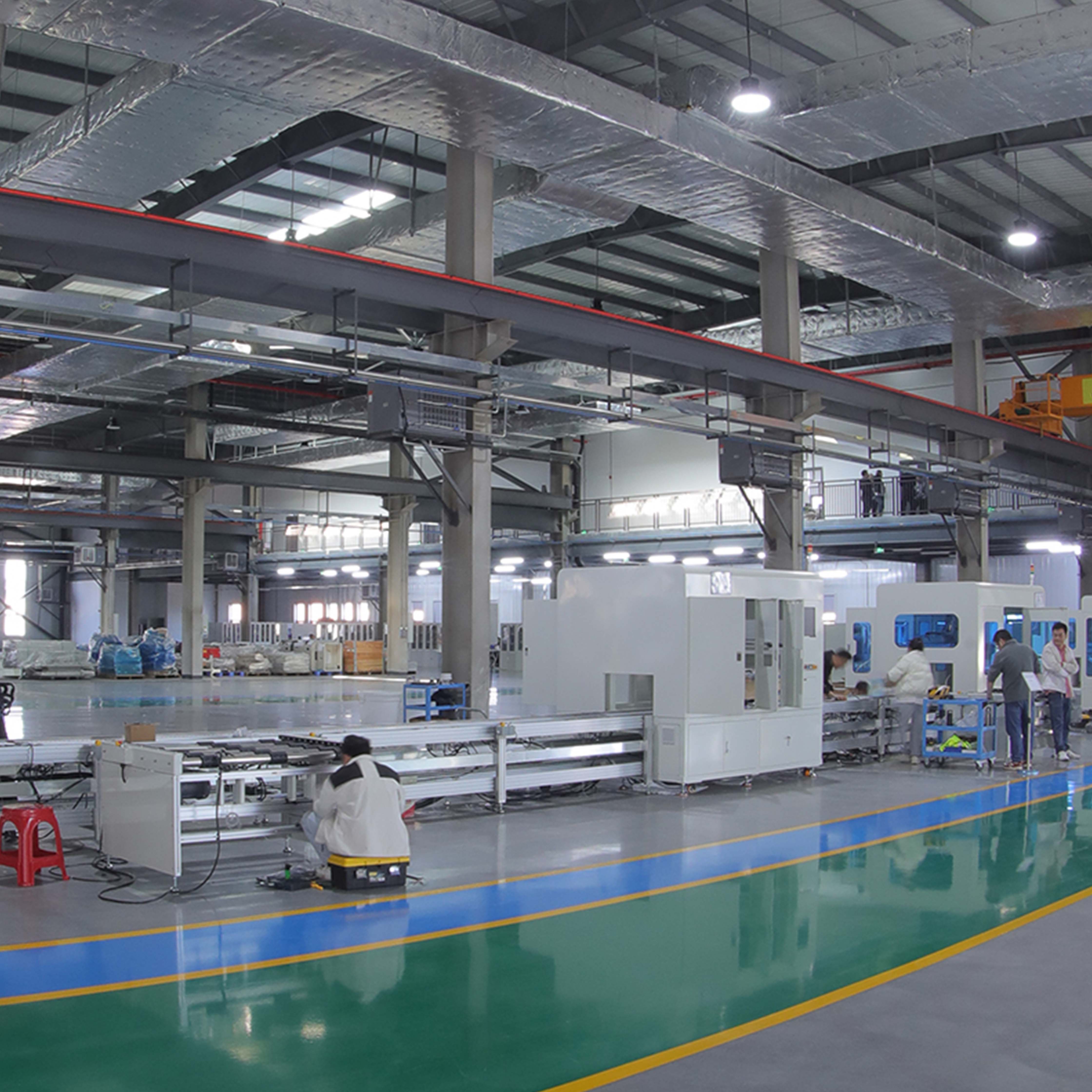
From automatic tray loading, OCV full inspection with auto-rejection, pole laser cleaning, and busbar laser welding to post-weld inspection, module testing, and automatic offline—fully unmanned material flow.
Explosion-proof water tanks and water-based fire suppression are engineered in, not retrofitted.
-
Soft-pack PACK line – 99.8% yield
MES + ERP interconnectivity. Data stored locally and uploaded in real time—no “reserved interfaces,” but production-ready integration.
-
Cylindrical PACK line – Dual-station configuration doubles throughput.
-
Containerized ESS integrated line – From cabin assembly and lifting to EOL and charge/discharge testing, all in one synchronized flow.
This is not equipment stacking.
This is turnkey solution engineering.
Your line does not need more machines.
It needs a better blueprint.
Still debating whether—and how—to upgrade?
Start with a conversation about where your real bottlenecks are.
💬 Drop “PACK” in the comments and I will share a configuration checklist tailored to your operation.
📩 Or DM me directly—some topics are better discussed in a call than typed into a post.